

Key Takeaways: Days in A/R measures how long it takes your practice to collect what it has earned. Commonly cited benchmarks put healthy performance at roughly 30 to 40 days, with high performers under 30. The average can hide problems, so also watch the share of A/R older than 90 days. Most A/R delays start at the front end, with eligibility errors, coding mistakes, and slow claim submission. A weekly routine of clean claim submission, fast denial work, and structured payer follow-up cuts A/R days faster than any single software change.
Introduction
If you want to reduce A/R days, start with this: every day a claim sits unpaid is a day your practice is financing the care it already delivered. Payroll, rent, and supplies do not wait for payers.
Days in accounts receivable (A/R) is one of the most watched numbers in practice management because it shows, in one figure, how quickly your revenue cycle turns care into cash. When it creeps up, cash flow tightens, even if your schedule is full.
This guide explains how to calculate days in A/R correctly, how to read your aging report, and how to bring the number down with a practical 90-day plan built for private practices.
What Is a Good A/R Days Number?
Benchmarks vary by source, specialty, and payer mix, so treat any single number as a guide rather than a rule. Commonly cited ranges for physician practices look like this:
| Days in A/R | Typical interpretation |
|---|---|
| Under 30 days | High performing |
| 30 to 40 days | Generally acceptable |
| Over 40 days | Needs attention |
| 60 days or more | Red flag, investigate immediately |
The average alone can mislead. A practice at 38 days can still have a serious problem if a large share of its balances is older than 90 days. Many advisors suggest keeping A/R over 90 days below roughly 15 to 20 percent of total A/R, and some recommend a stricter target near 10 percent. Because claims lose collectability as they age, the aging mix matters as much as the headline number.
How to Calculate Days in A/R
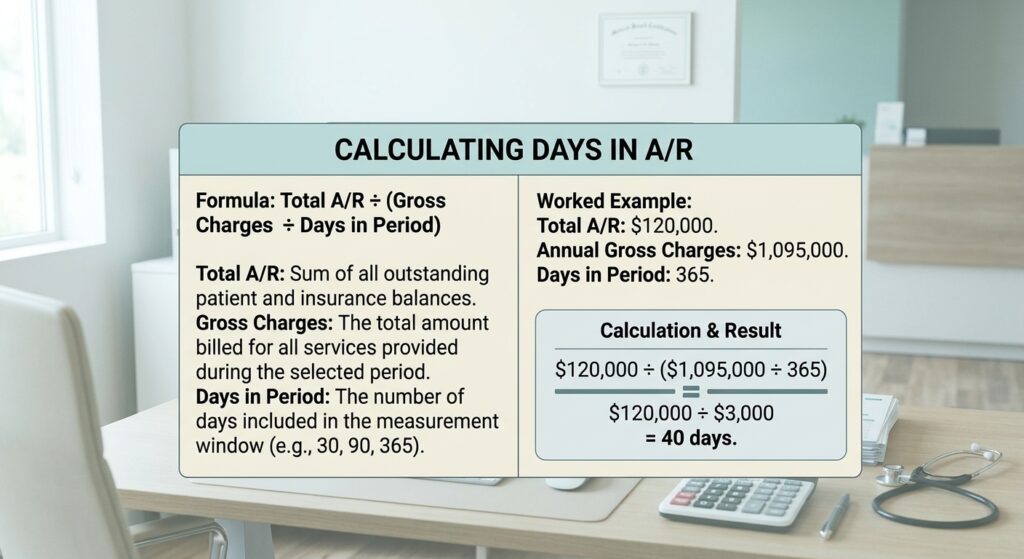
The standard formula is:
Days in A/R = Total A/R ÷ Average Daily Charges
Average daily charges are your gross charges over a period divided by the number of days in that period. Using 12 months smooths out seasonal swings.
Worked example:
- Total A/R today: $120,000
- Gross charges over the last 12 months: $1,095,000
- Average daily charges: $1,095,000 ÷ 365 = $3,000
- Days in A/R: $120,000 ÷ $3,000 = 40 days
Percent of A/R over 90 days:
- A/R older than 90 days: $24,000
- $24,000 ÷ $120,000 = 20 percent
Calculate both every month. Track aging by date of service, not by the date a claim was resubmitted, or resubmissions will hide how old a balance really is.
Why Reducing A/R Days Matters in Dollars
Lowering days in A/R releases cash that is already yours. Using the example above, with average daily charges of $3,000:
- Moving from 45 days to 35 days reduces A/R by about 10 days of charges
- 10 days × $3,000 = roughly $30,000 in one-time cash released
That is a one-time improvement to cash flow, not new revenue, but for a small practice it can cover payroll cycles, equipment, or a cushion against slow payer months. The bigger win is stopping older claims from aging into the range where collection becomes unlikely.
Where A/R Days Actually Get Stuck
Slow collections rarely come from one cause. They accumulate at specific points in the revenue cycle:
- Front end: wrong or unverified insurance, missing prior authorization, no patient estimate
- Charge capture and coding: delayed charge entry, missing modifiers, unspecified diagnoses
- Submission: claims held for days before they go out, rejections no one is working
- Payer response: denials and underpayments that sit untouched
- Follow-up: no routine for claims that are simply unpaid, not denied
- Patient balances: statements sent late, unclear responsibility, no payment options
The plan below addresses these in the order claims move through your practice.
A Practical Plan to Reduce A/R Days
1. Verify eligibility and authorizations before the visit
A claim that is wrong at registration is slow no matter how well it is worked afterward. Verify coverage, benefits, and referral or authorization requirements before every appointment, and record the patient’s estimated responsibility. Practices that skip this step end up with preventable denials and balances that are harder to collect after the fact. This is the core of insurance eligibility verification.
2. Capture charges and submit claims within 24 to 48 hours
Every day between the visit and submission adds a day to your A/R. Set a standard of 24 to 48 hours from date of service to clean claim submission, and track the number of unbilled encounters daily. A growing unbilled pile is an early warning that A/R days are about to rise.
3. Raise your clean claim rate
Claims that need correction go to the back of the line. Combine front-end scrubbing with review by someone who understands medical coding and payer-specific edits, since scrubbers catch formatting problems but not every coding or medical necessity issue. A commonly cited target is a clean claim rate of 95 percent or higher.
4. Work rejections the same day
Rejections never reach the payer, so the clock keeps running while nobody knows. Work clearinghouse rejection reports daily and correct and resubmit immediately.
5. Work denials within five business days
Prioritize by dollar value and filing deadline, identify the root cause, and fix the process behind recurring codes. Our guide to common denial codes and how to fix them walks through the most frequent causes. Consistent denial management is one of the fastest ways to move older claims out of the 60 to 90 day buckets.
6. Build a payer follow-up routine for unpaid claims
Not every slow claim is denied. Many are simply pending. Build a cadence such as this:
- Day 30 from submission: check claim status on every unpaid claim
- Day 45: escalate claims with no payer response or unclear status
- Day 60: work remaining claims by dollar value, with appeals if needed
- Day 90: review every claim for timely filing and appeal deadlines
Filing and appeal limits vary by payer and contract (Medicare, for example, generally requires claims within 12 months of the date of service), so confirm the limits in each contract and calendar them.
7. Post payments accurately and catch underpayments
Fast, accurate payment posting keeps your A/R clean. Compare each remittance against your contracted rates so underpayments are flagged and appealed instead of written off silently. See how payment posting and A/R follow-up supports this.
8. Tighten patient balance collection
Collect copays and known balances at the point of service, send statements promptly, and offer simple payment options. Patient balances are often the slowest part of A/R, so a clear estimate before the visit and a consistent statement cadence matter.
9. Review a weekly dashboard
What gets measured gets worked. Review these every week:
- Days in A/R and percent over 90 days
- Clean claim rate and first-pass denial rate
- Unbilled encounters
- Top denial reasons by payer
- Oldest claims by dollar value
Read Your Aging Report by Bucket
| Aging bucket | What it signals | Action |
|---|---|---|
| 0 to 30 days | Normal flow | Confirm claims are submitted and acknowledged |
| 31 to 60 days | Early slowdown | Check status, find pending or denied claims |
| 61 to 90 days | At risk | Escalate, appeal, review documentation |
| 91 to 120 days | Collectability dropping | Prioritize by dollar value, check filing limits |
| 120+ days | Write-off risk | Final appeal or adjustment decision |
A 90-Day Plan to Reduce A/R Days
| Timeframe | Focus | Outcome |
|---|---|---|
| Days 1 to 30 | Measure baseline, clear unbilled charges, work rejections daily, fix eligibility process | Accurate starting point, no new backlog |
| Days 31 to 60 | Work all denials, start the day 30/45/60 follow-up cadence, review top denial causes | Older buckets begin shrinking |
| Days 61 to 90 | Address root causes, tighten patient collections, set weekly dashboard | Sustained improvement, not a one-time cleanup |
Common Mistakes That Keep A/R Days High
- Tracking only the average and ignoring the over-90 bucket
- Measuring aging from resubmission dates instead of date of service
- Waiting for denials to arrive instead of following up on pending claims
- Writing off underpayments without comparing them to contract rates
- Batching claim submission weekly instead of daily
- Treating patient balances as an afterthought
Frequently Asked Questions
What is a good days in A/R for a private practice?
Commonly cited benchmarks put 30 to 40 days as generally acceptable and under 30 days as high performing, though specialty and payer mix change what is realistic for your practice.
How often should I calculate days in A/R?
Monthly at minimum, and weekly if you are actively working to improve it. Use a rolling 12-month charge figure to avoid seasonal distortion.
Can outsourcing reduce A/R days?
It can, mainly because a dedicated team works claims daily, follows a structured follow-up cadence, and focuses on denials and payer follow-up. Results depend on your starting point, your payer mix, and how clean your front-end data is.
How AMRG Helps Private Practices Reduce A/R Days
Alliance Medical Revenue Group supports US private practices with eligibility verification, claim submission within 24 to 48 hours of charge entry, denial management, payment posting, and payer follow-up, with US-based support and no long-term contracts. Our team works your aging report daily so older claims do not sit unworked.

Want a Clear Picture of Your A/R?
If your days in A/R are above 40, or your over-90 bucket keeps growing, a structured review usually shows where the delay starts.
Request an A/R review with AMRG at amrgbilling.com/contact-us