
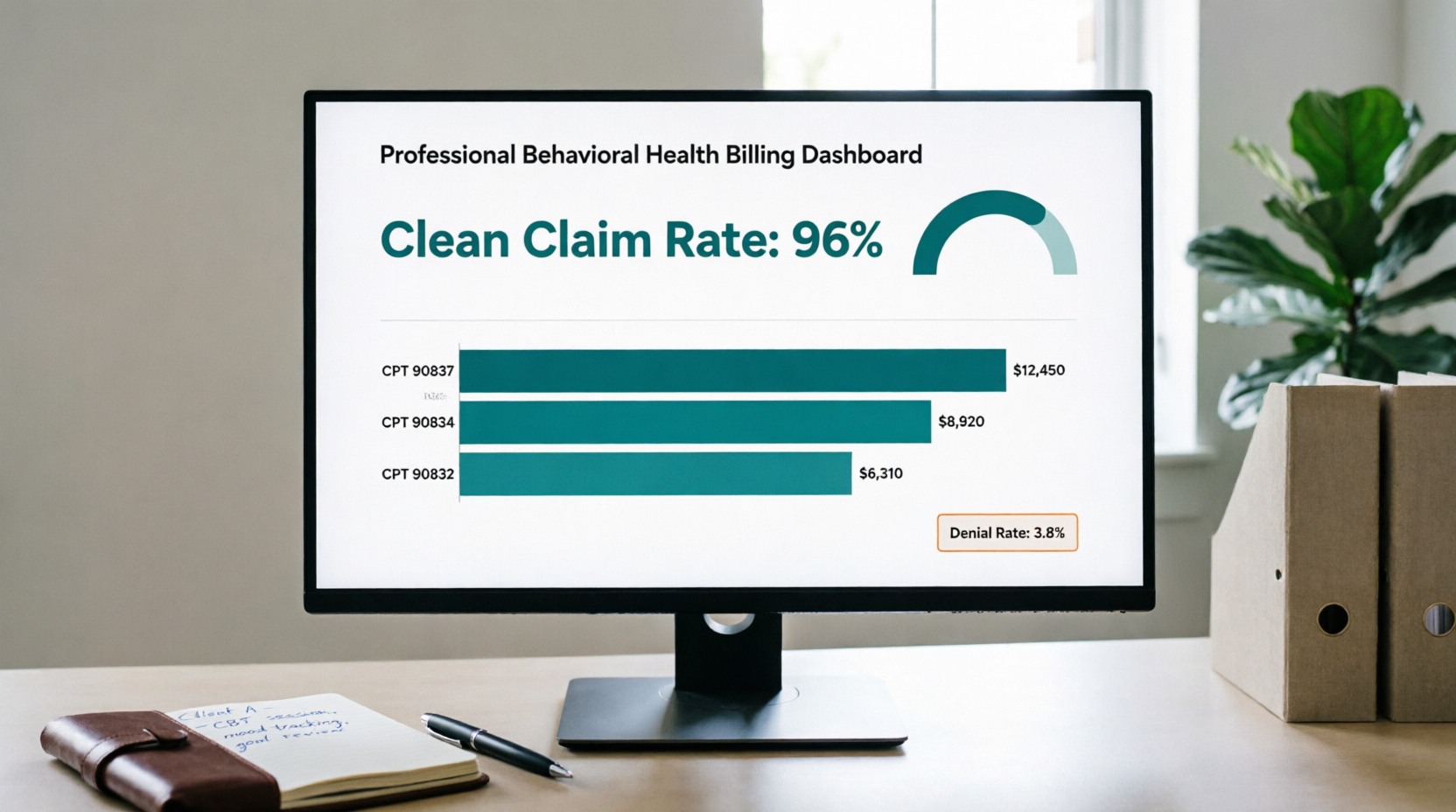
Key Takeaways: Mental health billing is the most error-prone specialty in US healthcare billing: time-based CPT codes, documentation precision, and payer-specific rules create a unique denial risk that generic billing processes cannot handle. The top denial cause for behavioral health claims is insufficient documentation, specifically missing session start and stop times. Telehealth billing for mental health is now permanent through 2027 with same-day parity reimbursement. LMFTs and LMHCs can now bill Medicare independently, creating new revenue opportunities for newly enrolled providers. AMRG’s certified billing specialists help mental health private practices reduce denials, maximize telehealth reimbursement, and improve clean claim rates, with US-based support and no long-term contracts.
Mental health providers are among the most underserved practices in US medical billing. Not because the reimbursement is poor in many cases behavioral health reimbursement is quite competitive but because the billing rules are uniquely unforgiving.
Unlike a surgical procedure where a fixed CPT code describes a fixed service, almost every mental health psychotherapy code is time-based. Bill one minute short of a threshold and the claim is wrong. Document “about an hour” instead of exact start and stop times and the claim is an audit target. Apply the wrong telehealth modifier and the claim denies automatically, not because the service was not provided, but because a two-digit code was entered incorrectly.
In 2026, these challenges are compounded by expanded Medicare eligibility for new provider types, permanent telehealth billing rules, and increasingly sophisticated payer audit systems targeting behavioral health documentation. This guide covers everything a mental health private practice needs to bill correctly, prevent denials, and optimize their revenue cycle in 2026, including the exact CPT codes, time thresholds, documentation requirements, and telehealth rules that determine whether your claims get paid.
What Makes Mental Health Billing Different From Other Specialties
Before diving into specific codes, it helps to understand why mental health billing generates more denials than most other specialties.
Three structural features make it uniquely challenging:
Time-based billing requires precision that other specialties do not. A cardiologist bills for a specific procedure — echocardiogram, stress test, cardiac catheterization. The procedure either happened or it did not. A therapist bills for minutes of face-to-face clinical work. If the documentation says “60-minute session” without exact start and stop times, many payers will deny or flag the claim for audit. The billing code selection is entirely dependent on how many minutes of therapy were actually documented.
Payer rules vary more than in any other specialty. Medicare, Medicaid, BCBS, UnitedHealthcare, Aetna, and Cigna each have different documentation standards, prior authorization requirements, session limits, and modifier requirements for mental health services. A billing process that works perfectly for Medicare may generate denials with a commercial payer for the same service.
Provider credential determines reimbursement rate. A psychiatrist, psychologist, LCSW, LPC, LMFT, and PMHNP can all bill the same CPT code for the same service — but receive different reimbursement rates depending on their credential and how they are enrolled with each payer. Getting this wrong means leaving significant revenue on the table or triggering overpayment recovery demands.
The Core Mental Health CPT Codes for 2026
Individual Psychotherapy Codes
These are the most frequently billed mental health codes. All three are strictly time-based, the specific code depends on the number of face-to-face therapy minutes documented in the session note.
| CPT Code | Service Description | Time Threshold | 2026 Medicare Rate (Non-Facility) |
| 90832 | Individual psychotherapy | 16–37 minutes | ~$79–81 |
| 90834 | Individual psychotherapy | 38–52 minutes | ~$128–135 |
| 90837 | Individual psychotherapy | 53+ minutes | ~$154–158 |
The critical rule: Time refers to face-to-face psychotherapy time only, not total appointment time, not documentation time, not case coordination time. If a session runs 55 minutes but only 48 minutes were direct therapy, the correct code is 90834, not 90837.
90834 is the most commonly billed outpatient mental health code nationally. The 38–52 minute range captures the standard therapy hour and represents the largest volume of behavioral health claims submitted every day.
Psychiatric Evaluation Codes
| CPT Code | Service Description | Who Can Bill | 2026 Medicare Rate |
| 90791 | Psychiatric diagnostic evaluation (no medical services) | All mental health providers | ~$163–170 |
| 90792 | Psychiatric diagnostic evaluation (with medical services) | Psychiatrists and PMHNPs only | ~$190–198 |
The key distinction: 90791 is for comprehensive intake assessments by non-prescribing providers, therapists, psychologists, LCSWs, LPCs. 90792 includes medication review and prescribing and can only be billed by providers with prescriptive authority. Billing 90792 when 90791 is correct is a compliance risk that triggers payer audits.
Family and Group Therapy Codes
| CPT Code | Service Description | Notes |
| 90846 | Family psychotherapy, patient not present | Documents family session without identified patient |
| 90847 | Family psychotherapy, patient present | Most common family therapy code |
| 90853 | Group psychotherapy | Per patient billing, not per session |
Group therapy billing note: 90853 is billed once per patient per session, not once for the entire group. A therapist seeing a group of 8 patients bills 90853 eight times on the same date of service. Each claim should list the individual patient’s information.
Crisis Psychotherapy Codes
| CPT Code | Service Description | Time Threshold |
| 90839 | Crisis psychotherapy | First 30–74 minutes |
| +90840 | Crisis psychotherapy add-on | Each additional 30 minutes |
Documentation requirement for crisis codes: The clinical record must demonstrate that the patient was in acute distress or at imminent risk of harm. Billing 90839 without crisis-level documentation is a significant compliance risk and a common audit target in 2026.
E/M Plus Psychotherapy Add-On Codes
When a psychiatrist or PMHNP provides both medication management (E/M service) and psychotherapy in the same session, they must use an E/M code plus one of these add-on codes, not a standalone therapy code:
| Add-On Code | Primary Code Required | Psychotherapy Time |
| +90833 | E/M office visit (99202–99215) | 16–37 minutes |
| +90836 | E/M office visit | 38–52 minutes |
| +90838 | E/M office visit | 53+ minutes |
Common billing error: Psychiatrists who provide medication management and therapy in the same appointment sometimes bill only 90837 or only an E/M code. The correct approach is E/M code + add-on code. Billing only one service when both were provided is undercoding, leaving legitimate revenue uncollected.
Telehealth Billing for Mental Health in 2026
Telehealth billing for behavioral health is now among the most valuable and most error-prone areas of mental health RCM. Two key facts define the 2026 landscape:
Telehealth flexibilities are permanent through December 31, 2027. The Consolidated Appropriations Act extended Medicare telehealth coverage for mental health services, meaning all psychotherapy codes remain approved for telehealth delivery, geographic restrictions do not apply, and patients can receive care at home without being required to first visit a qualifying healthcare facility.
The most expensive telehealth billing mistake is a wrong two-digit code. The difference between POS 10 and POS 02 determines whether a claim reimburses at the higher non-facility rate or the lower facility rate. For a 90837 session, that difference is approximately $42 per session. A practice seeing 20 telehealth patients per day and using the wrong POS code is leaving roughly $840 per day or over $200,000 per year, in uncollected revenue.
The Telehealth Modifier and POS Code Reference
| Situation | Correct Modifier | Correct POS Code | Rate Impact |
| Patient at home, audio-video | Modifier 95 | POS 10 | Non-facility (higher) rate |
| Patient at clinic/school/work, audio-video | Modifier 95 | POS 02 | Facility (lower) rate |
| Audio-only session (Medicare) | Modifier 93 | POS 10 or 02 | Same as audio-video |
| In-person session | No telehealth modifier | POS 11 (office) | Standard rate |
Audio-only billing note: Modifier 93 for audio-only mental health sessions is permanently approved under Medicare for behavioral health. Many commercial payers have followed suit. Always verify individual payer policies, audio-only coverage varies more than audio-video across commercial plans.
New in 2026 — LMFT and LMHC Medicare Billing
One of the most significant developments for mental health private practices in recent years is the expansion of Medicare billing eligibility to Licensed Marriage and Family Therapists (LMFTs) and Licensed Mental Health Counselors (LMHCs), which took effect in January 2024 and continues through 2026.
Key facts every LMFT and LMHC needs to know:
Reimbursement is at 75% of the physician rate. For CPT 90837 in 2026, this means approximately $115–118 nationally compared to the psychologist rate of approximately $154–158. This is not a penalty; it is the standard Medicare credential differential that also applies to NPs and PAs.
Enrollment must be completed through PECOS. LMFTs and LMHCs who are not yet enrolled in Medicare PECOS are billing Medicare zero, every session with a Medicare patient is uncollected revenue. Credentialing for Medicare enrollment typically takes 60–90 days. If this has not been completed, it should be the first priority.
Commercial payer enrollment is separate from Medicare. Being enrolled in Medicare does not automatically enroll an LMFT or LMHC with BCBS, Aetna, UnitedHealthcare, or other commercial payers. Each payer requires a separate credentialing application. AMRG’s credentialing specialists manage this process end-to-end, including re-credentialing and revalidation.
The Top 5 Denial Causes in Mental Health Billing
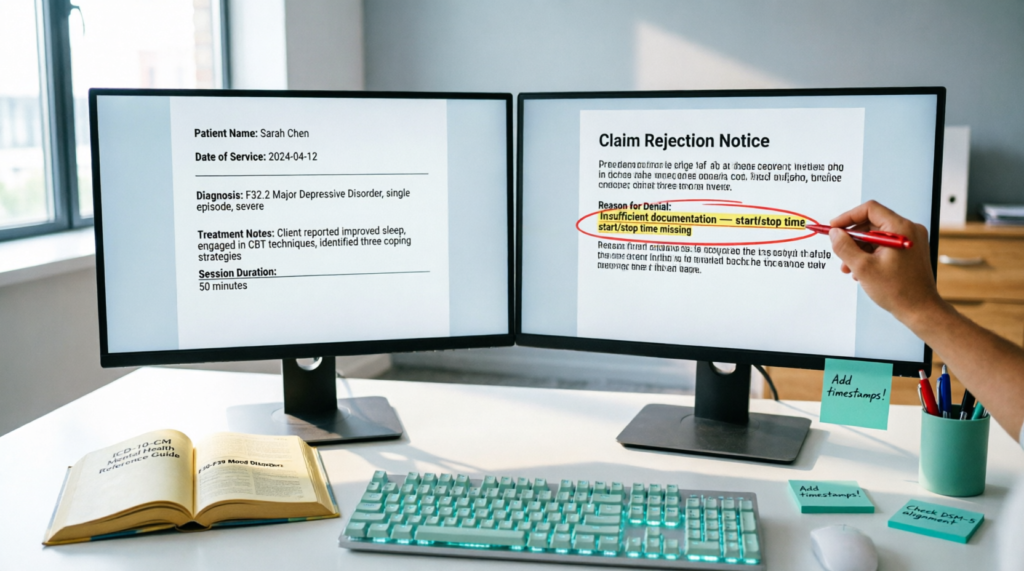
Understanding why mental health claims deny is the fastest path to improving clean claim rates and reducing A/R days. These are the five denial patterns that appear most frequently in behavioral health billing:
1. Missing or insufficient session documentation
The single most common denial in mental health billing. Payers require that session notes document exact start and stop times, specific therapeutic interventions used, patient response to treatment, progress toward treatment plan goals linked to an ICD-10 diagnosis, and clinical justification for the service level billed. A note that reads “Patient discussed anxiety. Made progress.” does not support a 90837 claim. It generates a documentation request, a delay, and often a denial.
The fix: Every session note should include: “Session start time: [time]. Session end time: [time]. Total face-to-face psychotherapy time: [X] minutes.” Then document interventions, patient response, and treatment plan progress in enough clinical detail to justify the code selected.
2. Wrong CPT code for documented time
Billing 90837 (53+ minutes) when the documented time is 48 minutes. Billing 90834 (38–52 minutes) when the note says “approximately 30 minutes.” These mismatches between documented time and billed code are caught by payer edit systems and generate automatic denials in most claims processing environments.
The fix: Create a documentation habit of recording exact minutes and confirming the CPT code before claim submission. A simple desk reference showing the three time thresholds (16–37 for 90832, 38–52 for 90834, 53+ for 90837) eliminates this error category almost entirely.
3. Incorrect telehealth modifier or POS code
As covered above, the wrong combination of modifier and place of service code causes automatic claim rejection. This is a pre-submission error that should be caught by a claim scrubber before the claim ever reaches the payer.
The fix: Build a telehealth billing checklist into the claims workflow. Every telehealth claim should be verified for modifier (95 or 93), POS code (10 or 02), and whether the payer requires any additional documentation for telehealth services.
4. Prior authorization not obtained or expired
Many payers require prior authorization for mental health services after a certain number of sessions, often 6 to 12. When authorization runs out and the practice continues billing without obtaining a new authorization, every subsequent claim denies.
The fix: Build a prior authorization tracking system that flags each patient’s authorization status and triggers a renewal request before the existing authorization expires. This requires either a dedicated staff member or an outsourced RCM partner who monitors authorization status across the practice’s full patient panel.
5. Bundling errors with E/M and psychotherapy
Psychiatrists and PMHNPs who bill both an E/M service and psychotherapy on the same day must use the add-on code structure (E/M + 90833/90836/90838). Billing a standalone therapy code (90837) alongside a standalone E/M code (99214) on the same date of service triggers an automatic bundling denial.
The fix: Apply Modifier 25 to the E/M code to indicate it was a significant and separately identifiable service, and bill the add-on psychotherapy code rather than a standalone therapy code. This is a modifier application issue, not a documentation issue, and once corrected stays corrected.
Documentation Standards That Prevent Denials and Survive Audits
In 2026, behavioral health documentation faces increased scrutiny from both Medicare and commercial payers. The following standards apply to every session note regardless of provider type or service setting:
Required elements for every psychotherapy session note:
- Patient name and date of birth
- Date of service
- Exact start and stop times of face-to-face psychotherapy
- Total face-to-face psychotherapy time in minutes
- CPT code billed and its time range
- ICD-10 diagnosis code(s) supporting medical necessity
- Specific therapeutic interventions used with clinical rationale
- Patient’s response to interventions
- Progress toward specific treatment plan goals
- Risk assessment where clinically indicated
- Provider name, credential, and signature
The most common audit trigger: Vague intervention descriptions. “Supportive counseling provided” does not pass audit. “CBT techniques applied to address cognitive distortions related to panic disorder; patient identified three alternative thoughts and practiced diaphragmatic breathing” does.
RCM Best Practices for Mental Health Private Practices
Beyond documentation and coding accuracy, mental health practices benefit from several RCM process improvements that reduce A/R days and improve collections:
Verify insurance eligibility and mental health benefits before every appointment. Mental health benefits are frequently separate from medical benefits, a patient with active medical insurance may have exhausted their mental health session limit, have a separate mental health deductible, or require a separate referral. Discovering this after the session means collecting from the patient, which is harder and slower than collecting from the payer.
Track authorization status weekly. Prior authorization management for mental health is among the most time-consuming administrative tasks in behavioral health. A systematic tracking process that monitors active authorizations, flags expiring auths, and initiates renewals proactively prevents the single most avoidable source of revenue loss in mental health billing.
Bill within 48 hours of the session. Time-based mental health claims are most accurately coded when submitted close to the date of service, when documentation is complete and the provider’s memory of the session details is fresh. Practices that batch billing weekly or biweekly accumulate coding errors that compound into denial patterns.
Work denials within five business days. Mental health denials have the same timely filing windows as all other claims, typically 90–180 days depending on the payer. Denials that sit unworked beyond 60 days become significantly harder to recover. A weekly denial work queue prioritized by dollar value and deadline prevents revenue from expiring.
Why Mental Health Practices Are Outsourcing Billing in 2026
The complexity of mental health billing: time-based codes, documentation standards, parity compliance, telehealth modifier rules, credential-based reimbursement differentials has made it one of the specialties where the gap between in-house billing quality and specialized outsourced billing quality is widest.
A general medical biller handles dozens of specialties. A specialized mental health billing team knows that 90834 requires exactly 38 to 52 documented minutes, that modifier 93 is valid for audio-only Medicare sessions, that LMFT Medicare reimbursement is at 75% of physician rate, and that a BCBS prior auth for psychotherapy typically covers 12 sessions before requiring renewal.
That specialized knowledge translates directly into measurable outcomes, higher clean claim rates, fewer denials, faster collections, and more revenue recovered from payers who would otherwise win by attrition.
How AMRG Supports Mental Health Private Practices

Alliance Medical Revenue Group provides US-based medical billing and RCM services specifically for private practices including behavioral health and mental health providers. Our certified billing specialists understand the unique documentation requirements, CPT code structure, and payer rules that govern mental health billing in 2026.
We handle eligibility verification before every appointment, submit clean claims within 24–48 hours of service, manage prior authorizations proactively, and work denials aggressively within five business days, giving mental health providers the financial predictability and cash flow they need to focus entirely on patient care.
AMRG serves practices billing under all major mental health provider credentials, psychiatrists, psychologists, LCSWs, LPCs, LMFTs, LMHCs, and PMHNPs across all major payers including Medicare, Medicaid, and commercial insurance.
Is Your Mental Health Practice Leaving Revenue on the Table?
If your practice is experiencing any of these symptoms, a clean claim rate below 95%, A/R days above 35, unworked denials older than 30 days, or billing staff who are not certain about telehealth modifier rules, your revenue cycle has recoverable room for improvement.
AMRG offers a free mental health billing audit for US private practices. In 30 minutes our billing specialists will review your current denial patterns, identify your top billing errors by CPT code, and give you a specific action plan whether you work with us or not.
Schedule your free mental health billing audit at amrgbilling.com/contact-us