

Key Takeaways: For Medicare, physical therapy units are based on total timed minutes for the day, not minutes per code. Evaluations and other untimed services do not count toward that total. PT claims need the GP modifier, and Medicare claims above the annual threshold need KX with documentation to support medical necessity. The KX threshold is $2,480 in 2026 and $2,540 for dates of service on or after January 1, 2027. Most PT denials trace back to documentation, modifiers, eligibility, or plan of care problems, so fixing the cause matters more than resubmitting.
Last reviewed November 2026 against the CMS CY 2027 Physician Fee Schedule final rule. Examples reflect the Medicare method. Always confirm each payer’s policy.
Physical therapy billing looks simple until you try to get it right. The 8-minute rule for physical therapy billing turns your treatment minutes into billable units, modifiers tell the payer who delivered the care and why, and a documentation gap can turn a paid claim into an audit finding. For private practice owners, one small error repeated across hundreds of visits becomes real lost revenue.
This guide walks through the CMS 8-minute rule with worked examples, the modifiers PT clinics rely on, and the denials that most often hold up therapy claims, along with how to fix the cause instead of just resubmitting.
Under the CMS 8-minute rule, Medicare PT billing is based on total timed minutes, not minutes per code. Add all timed-code minutes and divide into 15-minute units: 8–22 minutes bills 1 unit, 23–37 bills 2, 38–52 bills 3, 53–67 bills 4. Untimed services, such as evaluations, do not count toward the total.
The CMS 8-Minute Rule Explained
How Total Timed Minutes Become Units
For Medicare, you add up the minutes of all timed, direct one-on-one services delivered that day, then use that total to find the number of units you can bill. A minimum of 8 timed minutes is required to bill any unit.
| Total timed minutes | Units you can bill |
|---|---|
| 8 to 22 | 1 |
| 23 to 37 | 2 |
| 38 to 52 | 3 |
| 53 to 67 | 4 |
| 68 to 82 | 5 |
| 83 to 97 | 6 |
Once you know the total units, you assign them to the individual codes. Each code gets a unit for every full 15 minutes, and any remaining units go to the codes with the most leftover minutes.
Timed vs Untimed Codes
Only timed codes count toward the total.
- Timed examples: 97110 (therapeutic exercise), 97112 (neuromuscular re-education), 97140 (manual therapy), 97530 (therapeutic activities)
- Untimed examples: evaluations and re-evaluations (97161 to 97164), hot or cold packs (97010), and unattended electrical stimulation
Time spent on untimed services, documentation, or setup does not count toward the timed total.
A Worked Example
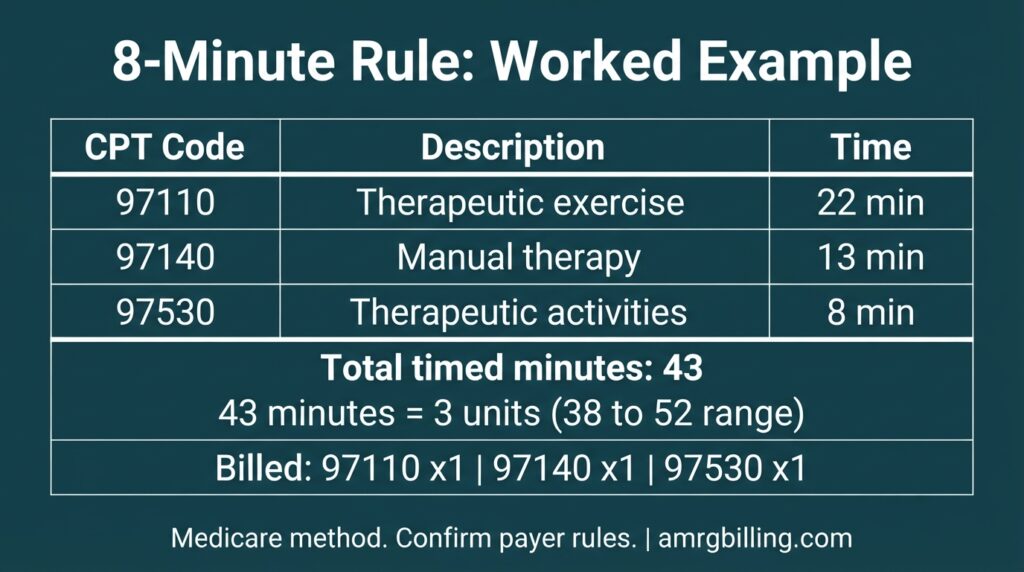
A patient receives 22 minutes of 97110, 13 minutes of 97140, and 8 minutes of 97530.
- Total timed minutes: 22 + 13 + 8 = 43
- 43 minutes falls in the 38 to 52 range, so you can bill 3 units
- 97110 has one full 15 minutes, so it gets 1 unit and has 7 minutes left over
- The two remaining units go to the codes with the most leftover minutes: 97140 (13) and 97530 (8)
Result: 3 units, one each for 97110, 97140, and 97530.
Common 8-Minute Rule Mistakes
- Rounding each code separately. Three codes at 10 minutes each total 30 minutes, which supports 2 units, not 3. Billing 1 unit per code overbills.
- Counting untimed or non-direct time. Evaluations, setup, and documentation time don’t belong in the total.
- Not documenting minutes per code. If the note shows only a total time, you can’t show how units were assigned.
- Applying the Medicare method to every payer. Some do not use it.
When Commercial Payers Differ
Some commercial payers use a different method, often a “substantial portion” approach, where each code needs more than half of a 15-minute unit. Because the same visit can produce different unit counts under different methods, build payer-specific unit rules into your billing process, not just the Medicare table.
Essential Physical Therapy Modifiers
GP, GO, and GN
These identify which discipline’s plan of care the service falls under: GP for physical therapy, GO for occupational therapy, and GN for speech-language pathology. A PT clinic bills GP. Leaving it off, or using the wrong one, is a common cause of modifier-related denials.
KX and the Therapy Threshold
Medicare sets an annual per-beneficiary threshold. Once a patient’s covered therapy passes it, claims need the KX modifier, which attests that the services are medically necessary and that the record supports it. Claims above the threshold without KX are denied.
| Year | KX threshold (PT and SLP combined) | OT threshold | Targeted medical review |
|---|---|---|---|
| 2026 | $2,480 | $2,480 | $3,000 |
| 2027 (dates of service on or after Jan 1, 2027) | $2,540 | $2,540 | $3,000 |
PT and SLP share one combined threshold, and OT has its own. Because a patient’s accumulated amount can include services from other providers, check it before assuming a patient is below the threshold. Adding KX is a single click. Having documentation that supports it is the real compliance work.
CQ for PTA-Furnished Services
When a physical therapist assistant furnishes a service in whole or in part, the claim carries the CQ modifier and Medicare pays at a reduced rate. CMS applies a de minimis standard so that very small PTA contributions do not trigger CQ, so confirm the current CMS thresholds and track PTA minutes for each service.
Modifier 59 and the X Modifiers
Some code pairs, such as 97140 with 97530, are bundled under NCCI edits. A modifier can allow separate payment only when documentation shows the services were distinct, for example performed in separate time intervals or on different areas. Many payers prefer the more specific XE, XP, XS, and XU modifiers to 59. Confirm current NCCI edits and payer preferences before applying either.
Payer-Specific Modifiers
Some commercial plans also want modifiers to distinguish rehabilitative and habilitative services (such as 96 and 97). Always check the payer’s policy.
Where Billing Software Falls Short on PT Claims
Billing software is useful for catching formatting problems before submission. But several PT billing decisions depend on judgment, not rules:
- Whether the note supports separate, distinct services. A software edit can flag a bundled pair. It can’t read your documentation and decide whether 59 or an X modifier is justified.
- PTA time and CQ. Someone has to know who furnished how much of each service.
- KX medical necessity. The software can prompt for KX. It can’t judge whether the record supports it.
- Cross-provider accrued amounts. The patient’s threshold can include other providers’ claims, so it needs to be checked, not assumed.
- Payer-specific unit rules. The same visit can legitimately produce different unit counts under different payers.
That is where a human-reviewed process matters: someone reads the note, checks the payer’s rules, and corrects the cause before the claim goes out.
Common PT Denials and How to Fix Them
CO-97: Bundled with Another Service
What it means: The payer considers the service included in payment for another service on the same claim.
Root cause: A modifier was missing or unsupported on a bundled pair such as 97140 and 97530.
The fix:
- Check the NCCI edit and the payer’s modifier policy
- Confirm the note shows distinct time intervals or distinct body areas before adding 59 or an X modifier
- Resubmit as a corrected claim or appeal with the supporting note
CO-4: Modifier Missing or Inconsistent
What it means: The modifier is invalid for the code, missing, or conflicts with another modifier.
Root cause: GP or KX left off, or modifiers applied automatically without checking payer requirements.
The fix:
- Review every modifier line by line
- Correct and resubmit
- Add the payer’s modifier rules to your reference sheet
CO-151: Frequency or Duration Not Supported
What it means: The payer says the information submitted does not support the number or frequency of services.
Root cause: Visit frequency exceeds what the plan of care or progress notes support.
The fix:
- Compare billed visits to the plan of care
- Appeal with progress notes showing measurable functional progress and the clinical reason for the frequency
- Update the plan of care when the patient’s needs change
CO-119: Benefit Maximum Reached
What it means: The patient has used the plan’s visit or dollar limit.
Root cause: Visit limits were not checked at eligibility, so the clinic kept treating past the benefit.
The fix:
- Verify remaining visits and limits before treatment starts, not after the denial
- Review the payer contract and your patient notice process before billing the patient
CO-16 or CO-50: Missing Information or Medical Necessity
What it means: The claim lacks required information, or the payer does not see medical necessity.
Root cause: Often a missing or late plan of care certification, outdated recertification, or thin progress notes. Medicare generally expects the plan of care to be certified within 30 days of the first treatment, recertified when needed (at least every 90 days), and a progress report at least every 10 treatment days. Confirm requirements with your Medicare contractor.
The fix:
- Obtain the missing signature or certification and document the reason for any delay
- Resubmit or appeal with the plan of care and progress notes attached
CO-197 and CO-29: Authorization and Timely Filing
What it means: Required authorization was missing, or the filing deadline passed.
Root cause: Authorization requirements were missed (common with commercial and Medicare Advantage plans), or claims waited too long to go out. Medicare generally requires claims within 12 months of the date of service. Commercial limits vary by contract.
The fix:
- Track authorization requirements and visit counts by payer
- Submit claims within 24 to 48 hours of the visit
- Calendar filing and appeal deadlines for every payer
For more on reading denial codes, see our guide to common medical billing denial codes.
Documentation That Holds Up in an Audit
Strong PT documentation does most of the work of preventing denials:
- Exact minutes for each timed code, plus total timed minutes
- A signed and dated plan of care with goals and frequency
- Timely recertification when required
- Progress reports at the required interval
- Functional outcome measures that show progress
- A clear medical necessity statement whenever KX is used
- Who furnished each service, including PTA involvement
How AMRG Supports Physical Therapy Practices
Alliance Medical Revenue Group supports US private practices with insurance eligibility verification, claim submission within 24 to 48 hours of charge entry, coding and modifier review, and denial management that works on root causes. Claims are reviewed by people, and our US-based team works with your practice directly, with no long-term contracts. If A/R is slowing you down, see our guide to reducing A/R days.

Frequently Asked Questions
Does the 8-minute rule apply to commercial payers?
Not always. The rule comes from Medicare. Some commercial payers use a different method, so confirm each payer’s policy before applying the Medicare unit table.
What is the KX modifier threshold for 2027?
For dates of service on or after January 1, 2027, the KX threshold is $2,540 for PT and SLP services combined, with a separate $2,540 for OT. The 2026 amount was $2,480.
Do evaluations count toward the 8-minute rule?
No. Evaluations and re-evaluations are untimed, so their time is not added to the timed total.
Want a Second Set of Eyes on Your PT Billing?
If you are seeing repeat modifier denials, unit disputes, or KX problems, a billing review usually shows where the process is breaking.
Request a PT billing review with AMRG at amrgbilling.com/contact-us