Most private practices underestimate the true cost of in-house billing by 40–60% because they only count salary and ignore training, turnover, software, and lost revenue from billing errors. Outsourced RCM typically costs 4–8% of collections compared to 10–15% for a fully loaded in-house team. The decision is not just financial — it is about expertise, technology access, and whether your staff’s time is better spent on patient care. AMRG offers US private practices a transparent, no-contract outsourced billing solution with a free 14-day trial and no setup fees.
Every practice manager has asked the question at some point: is it cheaper to keep billing in-house or outsource it?
The answer most practices get wrong because they are comparing the wrong numbers. They look at the cost of an outsourced billing company and compare it directly to a biller’s salary. That comparison is incomplete and almost always makes in-house billing look cheaper than it actually is.
In 2026, with payer complexity at record highs, prior authorization requirements expanding, and denial rates climbing for Medicare Advantage plans, the true cost of in-house billing goes far beyond a salary line on your P&L. This guide breaks down the real numbers, what in-house billing actually costs when everything is factored in, what outsourced RCM actually delivers, and how to make the right decision for your specific practice.
What In-House Medical Billing Actually Costs in 2026
Most practices calculate their in-house billing cost as: biller salary plus benefits. That number typically comes out to $45,000–$65,000 per year for a single biller in most US markets.
That calculation misses at least six additional cost categories that every practice with in-house billing is paying, whether they realize it or not.
Salary and benefits
A full-time medical biller in 2026 earns between $38,000 and $58,000 annually depending on experience, specialty knowledge, and location. Add employer-side benefits: health insurance, payroll taxes, paid time off, retirement contributions, and the fully loaded cost rises to $52,000–$78,000 per year for a single biller.
For practices that need more than one biller, which includes any practice doing over $500,000 in annual collections, multiply accordingly.
Training and certification
Medical billing is not a static skill. ICD-10 and CPT codes update annually. Payer policies change. CMS fee schedules shift. HIPAA compliance requirements evolve. A biller who was fully competent in 2023 may be creating costly errors in 2026 if they have not kept up with changes.
Keeping a biller current requires ongoing training investment, continuing education courses, CPC certification maintenance, coding update subscriptions, and time away from billing to complete that training. Budget $1,500–$3,000 per biller per year for this and that is a conservative estimate.
Software and technology
In-house billing requires a practice management system, a clearinghouse subscription for claim submission, an eligibility verification tool, a patient statement platform, and increasingly in 2026, a denial management tracking system. These tools together cost $500–$2,000 per month depending on the vendor and the size of the practice. That is $6,000–$24,000 per year in software costs that are invisible in the “we just pay a biller” calculation.
Turnover
The healthcare administrative workforce has one of the highest turnover rates of any industry. The average tenure of a medical biller is 2–3 years. When a biller leaves, the practice faces recruiting costs, onboarding time, a productivity gap of 3–6 months while the new hire learns the systems and payer preferences, and a spike in denial rates during the transition period.
The true cost of replacing a single biller, including recruiting, lost productivity, and the revenue impact of elevated denials during the transition, ranges from $15,000 to $30,000 per replacement event. For a practice that replaces its biller every 2–3 years, this adds $5,000–$15,000 per year to the real cost of in-house billing.
Compliance and liability
In 2026, HIPAA compliance is not optional and billing errors carry real financial risk. A single incorrect claim submission can trigger a payer audit. Repeated billing errors can result in overpayment demands, clawbacks, and in serious cases, exclusion from payer networks. Maintaining compliance requires documented processes, periodic audits, and staff accountability systems that most small practices simply do not have in place.
The opportunity cost
Every hour your front desk staff or practice manager spends on billing tasks is an hour not spent on patient experience, practice growth, or revenue-generating activities. In practices where the billing function has expanded beyond a dedicated biller into other staff roles, a common situation in small practices, the opportunity cost can exceed the direct billing cost.
The Hidden Costs of In-House Billing Most Practices Never Calculate

When all six cost categories are added together, the true annual cost of in-house billing for a small private practice typically looks like this:
- Biller salary and benefits: $52,000–$78,000
- Training and certification: $1,500–$3,000
- Software and technology: $6,000–$24,000
- Turnover amortized annually: $5,000–$15,000
- Compliance overhead: $2,000–$5,000
- Total true cost: $66,500–$125,000 per year
For a practice collecting $800,000 annually, that represents 8–16% of collections going to billing overhead before accounting for the revenue lost to denied or undercoded claims.
What Outsourced RCM Actually Costs in 2026
Outsourced medical billing companies typically charge between 4% and 8% of monthly collections. For a practice collecting $800,000 annually, that translates to $32,000–$64,000 per year.
That fee covers everything claim submission, denial management, payment posting, eligibility verification, patient billing, and reporting. There are no additional software costs, no training costs, no turnover events, and no compliance gaps.
The comparison looks like this:
| Cost category | In-house billing | Outsourced RCM |
| Staffing cost | $52,000–$78,000 | Included in % fee |
| Software | $6,000–$24,000 | Included |
| Training | $1,500–$3,000 | Included |
| Turnover | $5,000–$15,000 | Zero |
| Compliance overhead | $2,000–$5,000 | Included |
| Total annual cost | $66,500–$125,000 | $32,000–$64,000 |
For most private practices collecting under $1.5 million annually, outsourced RCM is demonstrably less expensive than a fully loaded in-house billing operation, even before accounting for the revenue improvement that comes from working with specialists.
The Performance Gap — Where the Real ROI Comes From
The cost comparison above assumes that in-house billing and outsourced billing produce identical results. They do not.
Specialized RCM companies work exclusively on billing. Their billers handle one specialty’s claims all day every day. They know the payer-specific quirks for UnitedHealthcare, Aetna, BCBS, and Humana in your state. They track denial trends across hundreds of practices and use that pattern recognition to prevent denials before they happen.
The performance difference is measurable:
- Industry average clean claim rate for in-house billing: 85–91%
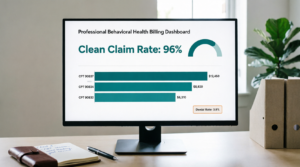
- Industry average clean claim rate for specialized outsourced RCM: 94–98%
For a practice submitting $800,000 in claims annually, a 7% improvement in clean claim rate means $56,000 in additional revenue that previously leaked through denials and write-offs.
That revenue improvement alone typically more than covers the cost of outsourcing.
When In-House Billing Makes Sense
Outsourcing is not the right answer for every practice. In-house billing makes more sense when:
- Your practice collects over $3 million annually and can justify a full dedicated billing department with a billing manager, multiple coders, and a denial management specialist
- You have an unusually complex billing situation that requires deep institutional knowledge built over many years
- You have a highly experienced, long-tenured biller with certified credentials who knows your payer mix intimately and shows no signs of leaving
For the vast majority of private practices, especially those with 1–5 physicians collecting under $2 million annually, the economics and performance data strongly favor outsourcing.
Why Private Practices Are Making the Switch in 2026

Three specific 2026 trends are accelerating the move toward outsourced RCM:
Payer AI auditing — payers are using machine learning to scrutinize claims more aggressively. An in-house biller keeping up with one practice’s claims cannot match the pattern recognition of a specialized billing company that processes thousands of claims across dozens of practices.
Prior authorization complexity — the administrative burden of prior authorizations has reached a point where small practices cannot handle it efficiently with generalist staff. Specialized billers who manage prior authorizations all day are dramatically faster and more successful.
Staffing instability — the post-pandemic healthcare administrative workforce remains volatile. Practices that outsource billing eliminate their single biggest administrative staffing risk.
Is Your Practice Paying More Than It Should for Billing?
Here are four questions to assess your current billing cost structure:
- Do you know your true all-in billing cost including software, training, and turnover amortized annually?
- Is your clean claim rate consistently above 95%?
- What was your last billing staff turnover event and what did it actually cost you?
- Are you spending more than 8% of collections on billing overhead?
If you cannot answer these questions confidently, you are likely underestimating what your current billing setup is actually costing your practice.
How AMRG Delivers Outsourced RCM That Pays for Itself
Alliance Medical Revenue Group provides US-based private practices with end-to-end revenue cycle management at a transparent percentage of collections, no hidden fees, no long-term contracts, and no setup costs.
Our certified billing specialists work exclusively with US private practices across 12+ specialties. We bring payer-specific expertise, denial prevention systems, and US-based account management that functions as a seamless extension of your practice team.
Practices that switch to AMRG typically see their clean claim rate improve within the first 30 days and their cost of billing decline within the first 90 days, net of our fee.
Ready to Find Out What Your Billing Is Really Costing You?
AMRG offers a free billing cost analysis for US private practices. In 30 minutes our team will calculate your true all-in billing cost, benchmark it against outsourced RCM pricing, and show you exactly what the switch would mean for your bottom line.
No obligation. No sales pressure. Just the numbers.
Schedule your free billing cost analysis at amrgbilling.com/contact-us